
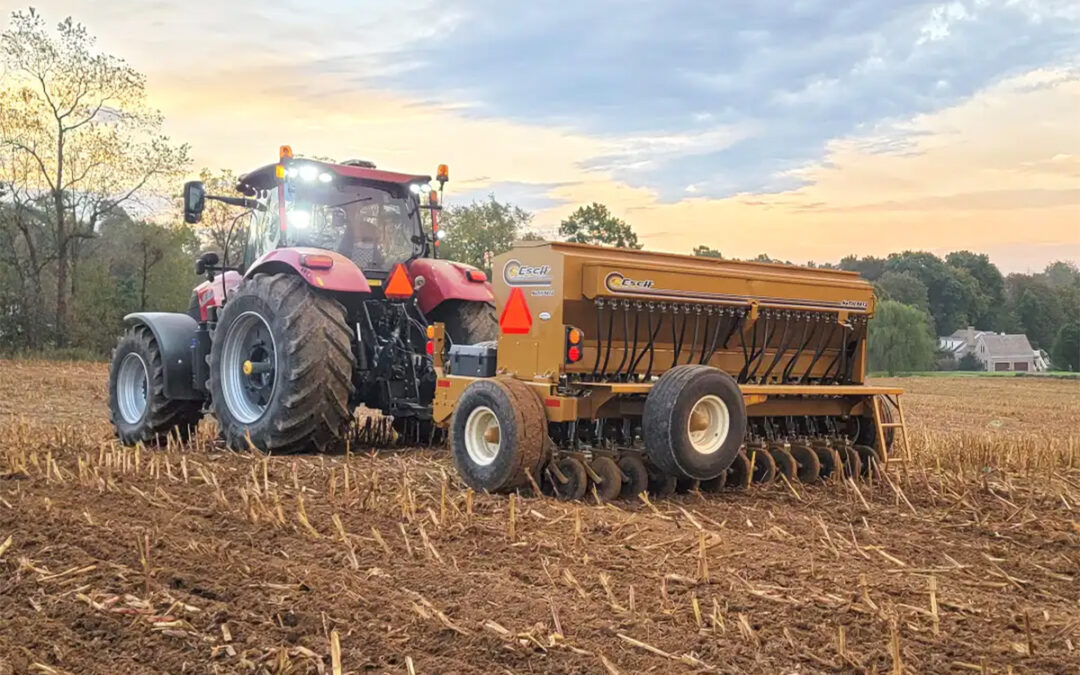
Acreage is a starting point for choosing a no-till drill, but the planting window often matters just as much. A drill that comfortably handles your annual acres may struggle if most of the work must happen during a few suitable days. A wider machine may save field time yet create problems at gates, on small fields, or with the tractor you already own.
Work through acreage, available hours, field capacity, and access together. Then compare Esch no-till drill models against the needs of your operation.
Count the acres due in the same window
List each seeding job and when it needs to happen. Separate pasture renovation, cover crops, and small grains if their planting periods differ. Count repeated passes when a job requires more than one seeding operation over the same ground.
Suppose an operation plans 80 acres of cover crops and 40 acres of pasture work. If both must be completed in the same window, the drill needs to cover 120 acres during that period. If the work happens in different seasons, size each window separately rather than treating the full year’s acreage as one deadline.
This distinction helps avoid buying capacity for work that is naturally spread out—or overlooking a short period when several jobs compete for the same machine and operator.
Estimate the field hours you can actually use
Use the number of suitable days and the hours the operator can spend seeding each day. Calendar days are not all workable days, and a nominal eight-hour day may include livestock chores, transport, or other jobs.
In a planning example, three suitable days with six available field hours per day provide 18 hours. Covering 120 acres in those hours requires an average of about 6.7 acres per hour.
Record how you have allowed for seed filling, turns, adjustments, and travel between fields. Some delays belong in the field-efficiency estimate below; time completely outside the seeding operation should be deducted from available hours. Do not count the same delay twice.
Estimate capacity from width and operating conditions
Iowa State’s farm machinery selection guidance describes field capacity in terms of effective working width, speed, and field efficiency. Efficiency accounts for the difference between continuous travel at full width and the work actually completed with turns, overlap, and operating delays.
Use this estimate with width in feet and speed in miles per hour:
Acres per hour = working width × speed × field efficiency ÷ 8.25.
Enter 75 percent efficiency as 0.75. Use a speed appropriate to the drill, seed placement, and field conditions, not the tractor’s maximum travel speed.
For illustration only, assume an 8-foot working width, 5 mph, and 75 percent field efficiency. The estimated capacity is 3.64 acres per hour. Covering 120 acres would take about 33 field hours under those assumptions, longer than the example’s 18-hour window.
An assumed 12-foot width at the same speed and efficiency gives 5.45 acres per hour, or about 22 hours for 120 acres. It still does not meet that window. These widths and speeds are hypothetical comparisons, not Esch model specifications or operating recommendations.
The useful result is the mismatch between workload and available time. Possible responses include revisiting the schedule, increasing operator availability, sharing the workload, or evaluating a different machine. Do not assume that increasing speed will preserve acceptable seed placement.
Match the drill to the tractor and seed
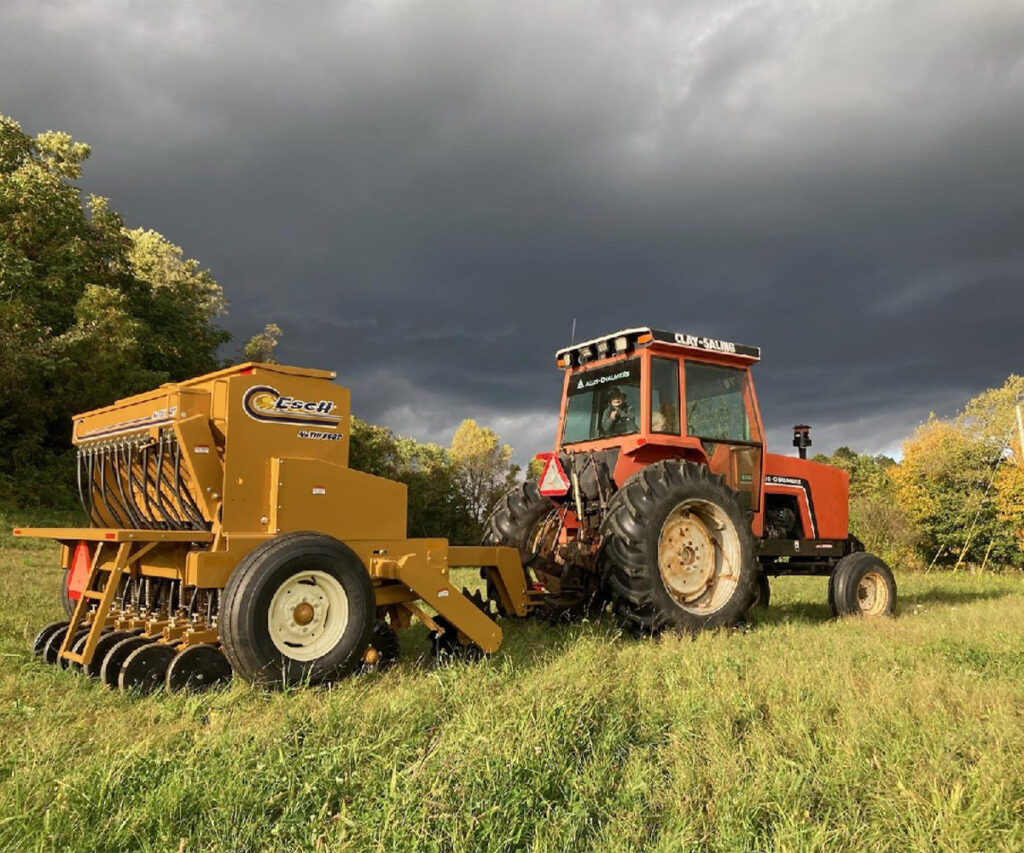
Field capacity does not establish tractor compatibility. Before choosing a specific configuration, provide the dealer with:
- Tractor make, model, and relevant specifications.
- Hitch or drawbar arrangement and hydraulic connections.
- Terrain, soil conditions, and expected residue.
- Seed species, mixtures, and intended placement requirements.
- Typical field size and number of separate fields.
Check the manufacturer’s current requirements for the exact drill. Avoid a universal horsepower-per-foot rule, and do not assume that a grain-seeding setup automatically handles every forage mixture.
Esch provides separate calibration guidance for its equipment. Setup and calibration need to match the seed and configuration you will use. Discuss those requirements as part of selection rather than leaving them until the first planting day.
Check working width and transport dimensions separately
Measure the narrowest gate, lane, and storage entrance on your route. Check transport width, height, length, and turning space for the chosen drill, including the position it must use to move between fields.
Working width describes how much ground the machine covers in a pass. Transport dimensions describe a different task. A drill can have adequate field capacity and still be inconvenient to move through your farm.
Also consider where you will fill seed, unfold or reposition equipment where applicable, and store the drill. Small fields with frequent turns may produce different results from one large rectangular field, even with the same total acreage.
Take a complete sizing worksheet to the dealer
Bring acres per planting window, available field hours, a realistic capacity estimate, tractor details, seed plans, and access measurements. If you already use a drill, actual acres completed and hours spent provide a useful comparison with the estimate.
Ackerman’s Equipment can discuss your requirements alongside the Esch drill models for agricultural seeding. Call 330-674-0495 with your worksheet to begin comparing options.